Business Strategy Development
Strategic clarity that aligns leadership, priorities, and execution. Schedule Your 15 Minute Strategy Clarity Call
What Is Business Strategy Development?
Business strategy development defines how an organization will reach its goals through structured alignment and disciplined execution.
Strategy is not a list of aspirations — it is the system used to achieve them.
An Effective Strategy Requires Two Essential Components:
- An operating plan that teams can follow — the Management Action Plan (MAP)
- A unified message the market can trust — the Integrated Marketing Strategy (IMS)
When internal direction and external communication move together, the entire organization advances in one coordinated direction.
Without structure for execution and clarity in communication, even strong ideas remain fragmented — trapped in disconnected efforts that never scale.
Why Most Business Strategies Fall Short
Most organizations do not struggle because they lack vision.
They struggle because alignment is never fully built.
Strategy begins with direction, but it succeeds through structure. When leadership priorities, operational planning, and communication are developed separately, even strong intentions lose momentum.
Without a defined operating framework:
-
Leadership priorities drift over time.
-
Teams work hard, but not always in sync.
-
Messaging evolves without reinforcing strategic intent.
-
Progress feels active, yet unfocused.
Over time, the organization becomes busy — but not coordinated.
The Role of Structure in
Developing a Business Strategy
Structure turns concepts into coordinated action. Without it, everyone interprets and reacts to problems differently instead of moving toward goals. Structure ensures leaders – management throughout the organization – knows what matters most, teams understand their responsibilities and the pace stays sustainable.
Internal structure shapes decision-making, priority-setting and sequencing. External structure organizes how the company presents itself to customers, partners and the public. Both are essential.
Without internal alignment, execution falls apart. Without external alignment, the market – which is your customers, prospects, peers, competition, vendors and adversaries – hear a different story than the one leadership intends to tell. Strategy becomes functional only when internal systems support the effort and external systems support the brand. Together, they form the backbone of forward motion.
This is where strategy becomes structured.
What Is A MAP®?
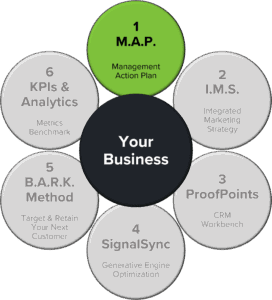
The MAP is the internal operating system that transforms strategy into daily execution. It aligns people around shared priorities, defines responsibilities, and creates the cadence required to maintain momentum.
Without an internal operating plan, a familiar pattern emerges: busy days without measurable progress. Departments duplicate effort. Teams re-align repeatedly. Tasks move forward — but rarely together.
The MAP changes that. It creates a shared view of goals and the stages required to reach them. Leadership gains a dependable framework for guiding teams. The organization gains rhythm, consistency, and scalable progress.
What The MAP® Does for an Organization
The MAP addresses five core areas that determine whether a strategy survives contact with reality.
Direction and Focus. The MAP establishes what matters now and what can wait. It forces prioritization, so effort compounds rather than scattering across too many initiatives that dilute results. When direction is clearly defined, decision-making speeds up, and distractions lose their pull.
Friction and Breakdown Points. Every business has places where things slow down, get duplicated, or fall through the cracks. The MAP addresses these pressure points so they can be reset intentionally instead of patched repeatedly. This reduces rework and hidden inefficiencies that drain time and morale.
Workflow Reality. The MAP charts how tasks move through the organization, not how they are supposed to move. This reveals where handoffs fail, where approvals bottleneck, and where ownership of projects and processes is unclear. Once these pathways are made visible, flow improves quickly.
Responsibility and Ownership. The MAP defines who owns which decisions and outcomes. This removes ambiguity that quietly erodes accountability and creates unnecessary escalation. People gain autonomy without losing alignment.
Measurement and Rhythm. The MAP defines what success looks like and how often progress is reviewed. This creates a predictable operating cadence that replaces reactive fire drills. When execution becomes steadier, confidence follows.
Common Mistakes Without a MAP®
Common challenges include stalled projects, unclear ownership, competing priorities and repeated misalignment. Without an internal operating backbone, strategy becomes a collection of well-meaning activities rather than coordinated progress.
What An IMS Includes
Positioning That Makes Sense
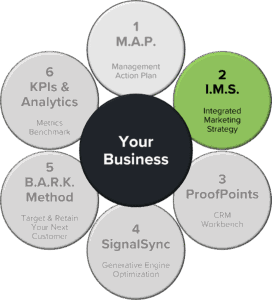
The IMS defines how you should be understood — and why someone should choose you. This is not about slogans. It is about precision. When positioning is clear, marketing stops competing for attention and starts resonating with the right audience.
Language People Recognize
The IMS establishes shared language across leadership, marketing, and sales. When the message is repeated clearly and consistently, familiarity builds trust and shortens the path to decision.
Customer Journey Awareness
The IMS maps how people discover, evaluate, and decide. Communication aligns with real behavior instead of internal assumptions.
Channel Intentionality
IMS defines where attention matters and how each channel supports the whole. Presence becomes deliberate rather than reactive.
We once worked with an organization whose teams communicated in completely different tones. Sales emphasized speed. Marketing emphasized quality. Operations emphasized reliability. Customers received mixed signals from the same company. After implementing an IMS, the organization aligned its voice — and trust increased across every audience
Why The IMS Prevents Marketing Waste
The IMS prevents marketing waste by grounding every message in strategic priorities. Less correction. More compounding effort.
How The MAP and IMS Operate Together
in Real Strategy Development
The MAP and IMS are not separate initiatives. They are interdependent frameworks that form a complete strategy.
- The MAP defines direction and organizes internal effort.
- The IMS communicates that direction consistently to the market.
When one is missing, the strategy loses balance.
- The MAP without the IMS creates disciplined execution but leaves customers uncertain about what the organization truly stands for.
- The IMS without the MAP produces polished messaging that the organization cannot consistently deliver.
When both operate together, alignment becomes visible.
- What leadership decides guides execution.
- What teams execute reinforces the message.
- What customers expect matches what they experience.
This alignment is what allows an organization to grow without distortion.
-
- It is how strategy becomes durable.
- It is how confidence compounds — internally and externally.
- It is how growth accelerates without breaking trust.
Practical Outcomes When an Organization
Uses THE MAP and IMS
When the MAP and IMS are fully implemented, coordination improves immediately.
Leaders make decisions with visible priorities.
Teams collaborate with shared context.
Marketing reflects operational reality instead of assumptions.
Execution becomes steadier. Communication becomes consistent. Momentum becomes measurable.
Organizations experience:
-
Clearer decision-making
-
Stronger cross-functional alignment
-
Predictable timelines for major initiatives
-
Messaging customers recognize and trust
-
Reduced wasted effort
-
Compounding progress toward long-term goals
The MAP and IMS turn strategy into
a daily operating discipline — not a quarterly exercise.
Once alignment and communication are fully established, strategy no longer requires stabilization. It is ready to extend.
Acceleration is not a new direction. It is the next layer of disciplined growth — building on the foundation already in place.
SignalSync
SignalSync extends your strategic clarity into digital visibility. Once your internal systems and messaging are aligned, SignalSync ensures your presence across search engines, AI platforms, and local discovery channels reflects that alignment consistently.
Visibility becomes intentional rather than incidental.
The B.A.R.K. Method
The B.A.R.K. Method strengthens precision. With foundational alignment in place, deeper audience insight allows communication to sharpen and reach to compound.
Understanding behavior transforms strategy from structured to strategic advantage.
ProofPoints
While the MAP defines direction, and the IMS defines expression, it’s the ProofPoints CRM that sustains momentum.
ProofPoints supports execution — organizing tasks, automation, communication, and reporting so the strategy operates daily without erosion.
The MAP and IMS form the foundation. SignalSync,
The B.A.R.K. Method, and ProofPoints help you scale it.
What Changes When the
Foundation Is Set
When internal structure and external alignment are in place, performance begins to shift — often faster than expected.
The Earliest Signals Appear Internally
- Meetings shorten because decisions are clearer.
- Priority shifts require less reorientation.
- Tension between departments decreases as assumptions are replaced with shared direction.
Operational Gains Follow
- Handoffs become smoother.
- Redundant effort declines.
- Execution grows more predictable because the plan behind it is visible to everyone.
Then The Market Responds
- Prospects hear one coherent message.
- Positioning attracts the right audience instead of a broad one.
- Trust forms earlier in the buying process, shortening the path to commitment
These improvements do not come from doing more.
They come from doing fewer things — deliberately and consistently.
Who THE MAP and IMS Are Built For
The MAP and IMS are designed for organizations that are growing — and beginning to feel the strain of that growth.
They serve leadership teams who want structure before scaling further.
Organizations tired of disconnected initiatives competing for attention.
Teams that value durable momentum over temporary fixes.
This framework is not built for companies seeking a single campaign or a fast workaround.
- It requires participation.
- It requires honesty.
- It requires follow-through.
These improvements do not come from doing more.
They come from doing fewer things — deliberately and consistently.
Foundation First, Then Forward
Most partnerships move through three phases over six to nine weeks.
The process is deliberate — designed to create steady progress through a clear structure.
Phase 1: Discovery (Weeks 1–2)
We listen. You talk.
We both determine if this is the right fit.
Then we meet with your leadership team to understand goals, obstacles, processes, and people. You receive an honest assessment of what is working — and what is not.
You leave with clarity about whether THE MAP and IMS are the right solution for your challenges.
Phase 2: THE MAP Development (Weeks 3–5)
We design the internal operating system that connects leadership decisions to daily execution.
Priorities, workflows, ownership, and operating rhythm are defined and tested against your real environment — not theory.
Your team gains one shared reference point.
Decisions accelerate.
Alignment strengthens.
Phase 3: IMS Creation (Weeks 6–9)
With the internal foundation set, we build how your organization shows up externally.
Positioning. Language. Customer journey. Channel strategy.
Marketing, sales, and leadership align around one coherent narrative.
What you say matches what you do.
What you promise matches what you deliver.
Clean. Controlled. Not hype.
What You Have After Nine Weeks
You Have
- A defined internal structure your leadership team understands and uses
- Clear priorities connected to measurable outcomes
- Ownership and decision pathways that reduce friction
- A unified external message aligned with operational reality
- A shared rhythm for reviewing progress and adjusting intentionally
The Organization No Longer Operates On Assumptions
- Execution becomes predictable.
- Communication becomes consistent.
- Momentum becomes measurable.
After nine weeks, you do not receive a document.
You leave with an operating foundation.
What Happens Next
Once the foundation is set, the work shifts from alignment to refinement.
Some organizations continue strengthening execution through ProofPoints. Others activate SignalSync or B.A.R.K. to accelerate visibility and insight. Some simply operate with greater clarity and confidence.
- The difference is not in adding more initiatives.
- It is in executing the right initiatives with structure.
This creates forward motion without fragmentation.
Frequently Asked Questions
What is the development of a business strategy?
It is the process of defining how an organization will achieve its goals through internal alignment (The MAP) and external communication (IMS). These frameworks create the structure needed for consistent execution.
Do small and mid-sized companies need The MAP and IMS?
Yes. Strategy requires structure, not size. The MAP and IMS scale easily because they organize decision-making, communication, and execution at any level.
How long does it take to build a complete strategy?
Most organizations can develop a foundational The MAP and IMS within six to nine weeks and refine them as conditions evolve.
When is a strategy ready for acceleration?
When teams are aligned, messaging is consistent, and execution follows a predictable rhythm. At that point, systems like SignalSync and ProofPoints can be introduced effectively.
How often should a strategy be updated?
The MAP is reviewed regularly as part of your operating cadence. The IMS evolves as customer insights deepen and market conditions shift.
Developing a business strategy is about creating a system your organization can trust. The MAP brings structure to how you operate. IMS brings consistency to how you communicate. Together, they give your team the confidence to execute with purpose and give your customers a reliable experience they can count on.
The organizations that sustain momentum are not the ones with the most ideas. They are the ones with the strongest foundation. The MAP and IMS provide that foundation. Once they are in place, everything that follows, whether that is expanded reach, refined messaging, or tighter operations, becomes easier, more predictable, and far more effective.
If you are ready to build a foundation that makes everything else simpler, this is where to begin.
Schedule a 15-Minute Intro Call. No pressure,
Just honest conversation about whether we are the right fit.
Our Promise
To build, and protect, the integrity and trust of the brands that we serve.
Call: 888.515.2789
Text: 614.665.1992
Email: info@efriendmarketing.com
OH Office: 8711 Arrowtip Lane • Lewis Center, Ohio 43035
CT Office: 32 Horseshoe Ridge Rd • Sandy Hook, CT 06482