A Marketing Partnership Built On
Foundation, Method, Tools And Results
What It’s Like
to Work With Us
Most business owners don’t wake up asking for a new agency or another consultant. They wake up asking deeper and more direct questions like:
How do I get everyone aligned? How do I stop reacting and start leading? How do I grow without breaking what already works?
If you’ve built a business from the ground up or took over an existing organization, the challenge usually isn’t effort. It’s fragmentation. Observe the obvious: strategy lives in meetings. operations live in inboxes. marketing lives in tools. customer insight lives in someone’s head. The business moves forward, but not always together—and frequently with contradiction.
That’s where our work begins.
We don’t step in to run a single campaign or install another system. We work alongside leadership and management to connect the parts of the business that should already be working together, so growth becomes intentional, repeatable and sustainable.
This page explains how that partnership works and what you can expect when we work together.
Our Engagement Model
Is a Partnership, Not a Project
Why Most Agency
Relationships Break Down
Most agency relationships fail for reasons that have nothing to do with talent or intent. They fail because the work starts too far downstream.
The problems start when tactics get deployed before alignment exists. Oftentimes, tools get introduced before decisions are clear and the Marketing Department (if you have one) is expected to perform before the concept is fine tuned and everyone has agreed on where it’s going, who it’s for or how the results get measured.
The outcomes look familiar: activity without traction, busy teams without momentum, short-term wins that don’t compound. When strategy, operations and visibility are disconnected, even good ideas struggle to turn into consistent results.
We Don’t Work In Handoffs. We Work In Partnerships.
Every project has an endpoint, but a partnership has longevity. Instead of delivering recommendations and stepping away, we stay engaged across strategy, systems, visibility and learning so the focus stays clear and the structure takes hold. The result is a shared context with complete accountability and defined outcomes.
We spend time with your people learning how decisions are made, determining workflows between people and departments and where friction shows up. We collaborate with leadership and teams—not around them—and adjust as conditions change. Real businesses don’t operate in static environments and the work shouldn’t pretend otherwise.
This engagement model is designed to support three things: fixing what’s broken, strengthening what works and building a foundation that grows with you.
What Our Clients Experience
Family Moving Company
Dan M., Owner & President
Est. 1987 | Tampa, FL
“My father built this company over thirty years, but by the time I took over we were running on three different systems, customer info lived in random emails, and nobody could find anything. What changed everything wasn’t the technology—it was finally seeing how our business actually operated. The MAP process exposed handoffs between dispatch, crews, and billing that we’d been stumbling over for years, and once we could see the friction, fixing it became obvious. Now our entire operation runs from one system, our crews know what’s happening before they arrive, and when someone calls asking about their grandmother’s china cabinet, anyone on our team can pull up the notes in seconds. The SignalSync work made us visible in local searches we never appeared in before, and last month alone we had four families mention they found us through Google Maps—that rarely happened before.”
Professional Association
Rebecca C., Executive Director
Founded 2023 | 150+ Members | Statewide
“We launched with energy and great people but absolutely no idea how to run an association—our volunteer board couldn’t remember what we decided last month, member communications were chaos, and we were tracking renewals in a spreadsheet. eFriend helped us realize we weren’t failing, we just didn’t have structure. The MAP gave our board an operating rhythm we could maintain, the IMS clarified our message from ‘another networking group’ to ‘the alliance advancing coastal design standards in Florida,’ and ProofPoints automated renewals and event registrations so our board could see membership activity without constantly asking me for reports. Within six months we went from 92 members wondering if we’d survive to 150+ members asking when we’re expanding to other regions—the difference wasn’t just growth, it was finally feeling like a real organization.”
Interior Design Studio
Caroline B., Principal Designer
Est. 2016 | Charleston, SC
“For years I told myself I’m a designer, not a systems person, which was really just an excuse for why my assistant Sarah and I were drowning in sticky notes, scattered text messages, and vendor contacts saved in my phone as ‘Michael fabrics.’ The MAP process showed us our real problem wasn’t technology—it was that we’d never defined how projects should flow, so we were reinventing everything for every client. eFriend set up ProofPoints in a way that actually made sense to us, and now every project has a clean timeline, all our vendor contacts live in one place, and Sarah and I can both see what’s happening without constant check-ins. The SignalSync work fixed something I didn’t know was broken—our business info was listed incorrectly in a dozen places online—and within weeks we started getting inquiries from exactly the neighborhoods we wanted to work in.”
How We Work Together: Fix First, Then Grow
Stabilize What’s Getting in the Way
Most problems don’t usually show up where they originate. For example, a stalled sales pipeline might trace back to confusing positioning. In another instance, operational disorder might stem from conflicting priorities between departments. Thirdly, marketing campaign underperformance often points to messaging gaps that run deeper than any campaign can fix.
Before progress can improve, stability has to exist. We work with you to identify the specific causes including: goals, roles, handoffs, messaging and expectations across the business—not just the symptoms. When problems are identified and addressed, solutions become simpler and staff stops guessing. The Decision makers are released from putting out fires and the progression to regain solid footing becomes more obvious.
Build Standards That Reinforce the System
Once the business is grounded, we shift toward processes that reinforce the system instead of stressing it. That means aligning people and departments to focus on strategy with execution, visibility with delivery and ambition with capacity.
When leadership has presented clear directives, teams can move together and faster. The various priorities are shared quite visibly and decisions are easier to execute. When expectations are obvious, accountability happens naturally. As a result, marketing stops feeling like a gamble and starts functioning as part of the operating rhythm.
At the same time, we pay attention to how customers respond as visibility increases. It will be quite apparent to all what resonates, what confuses, what builds trust and what drives decisions. This learning loop allows the business to refine its message and strengthen relationships instead of starting from scratch with every initiative.
The goal isn’t to reach everyone. It’s to serve the right people well and to keep getting better at it.
Why Long-Term Partnerships
Outperform One-Time Projects
When work compounds over time, improvements don’t reset every quarter because the strategy is evolving as systems mature. The result is brand messaging visibility strengthens and the learning accelerates so those involved don’t have to relearn every time conditions change.
Instead of chasing fixes, you build capability, the kind that allows businesses to adapt and lead in changing markets without losing coherence.
Where Every Engagement Starts
Before we touch marketing channels, websites, automation or visibility efforts, we focus on creating transparency inside the business and consistency outside of it.
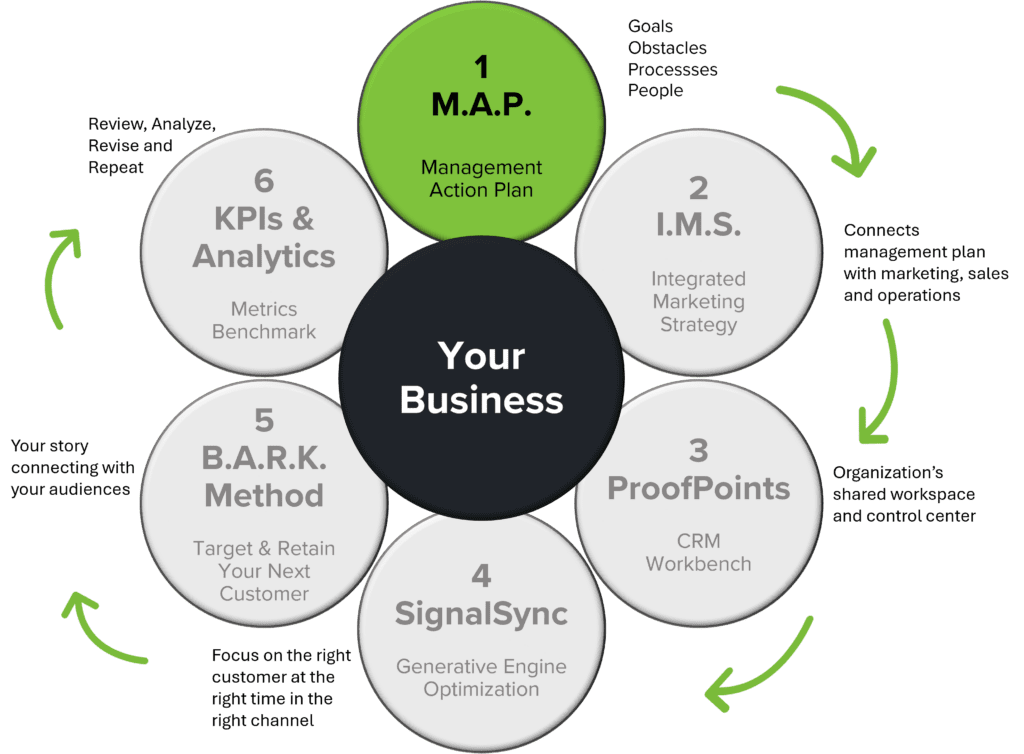
That foundation lives in two connected frameworks: the Management Action Plan (MAP) and the Integrated Marketing Strategy (IMS). Together, they align goals, clarify ownership, define positioning and connect leadership decisions to daily execution. Everything else builds on this work.
If you’ve ever wondered how to align your business before scaling—or how to connect strategy to results without adding another layer of complexity—this is where the journey begins.
Your Path Forward: What to Expect
Phase 1: FoundatioN (Weeks 1–6)
- Intro Call: We listen to your situation and determine if we’re the right fit
- Discovery: We meet with your leadership team to understand goals, obstacles, processes and people
- MAP Development: Your Management Action Plan takes shape, giving your team an operating rhythm they can follow
- IMS Creation: Your Integrated Marketing Strategy connects leadership decisions to everyday execution
Outcome: Your team moves in one direction with shared priorities and clear language.
Phase 2: Operations (Weeks 4–8)
- ProofPoints Setup: Your CRM and workflow system gets configured for how your business operates
- Team Onboarding: Role-based training ensures adoption across departments
- Initial Automation: Key workflows launch so follow-ups happen without manual effort
Outcome: One shared workspace where everyone knows
Decisions accelerate.
Alignment strengthens.
Phase 3: Visibility (Weeks 6–12)
- Website Development*: Strategy-first site build that customers and AI understand instantly
- SignalSync Launch: Your digital signals align across search, maps, listings and AI platforms
- Review Momentum: Systems activate to build steady trust signals
Outcome: Customers can find you easily and consistently wherever they look.
Phase 4: Refinement (Weeks 12+)
- B.A.R.K. Method Integration: Brand, Audience, Reach and Knowledge insights sharpen your message
- Performance Review: We analyze what’s working and adjust what isn’t
- Continuous Improvement: Your system gets smarter as data guides decisions
Timeline Notes
- Phases often overlap—we don’t wait for perfection before moving forward.
- Your specific timeline depends on business complexity and team availability.
- Most organizations see measurable improvement
by day 90. - The system is designed to compound over time, not reset every quarter.
Partnership Requirements: Is This the Right Fit?
Our system creates clarity, alignment, and predictable growth—but only when certain conditions are met.
Before we begin, here’s what successful partnerships require:
Leadership Commitment
- Decision-maker involvement: Owner, CEO, or President, and key personnel participate in discovery and strategic planning
- Time investment: Leadership attends key planning sessions and quarterly reviews
- Authority to implement: The people we work with can make decisions and drive adoption across departments
Strategy fails when leadership delegates it entirely.
We guide, but you lead the change.
Team Readiness
- Minimum team size: Generally 5+ employees (though exceptions exist for other scenarios)
- Willingness to adopt new systems: Team members must be open to changing how they currently work
- Participation in onboarding: Staff attend role-based training and learn the new workflows
Tools only work when people use them.
We need your team’s cooperation, not just tolerance.
Honest Communication
- Transparency about challenges: Share what’s really happening, not what sounds good
- Access to current data: We need to see existing metrics, workflows, customer feedback and pain points
- Openness to feedback: Some of what we discover may be uncomfortable to hear
We can’t fix what we can’t see.
Sugar-coating problems wastes everyone’s time.
Realistic Timeline Expectations
- 1-year minimum commitment: Real transformation doesn’t happen in 30 days
- Sequential implementation: We build the foundation before acceleration—for the best results
- Patience with adoption: Teams need time to internalize new systems and workflows
Rushing creates half-implemented chaos.
Strategy requires structure and time to take root.
Accountability and Follow-Through
- Action between sessions: You’ll have tasks to complete, decisions to make, and information to gather
- Meeting commitments: Show up to scheduled calls and reviews prepared
- Implementation ownership: We guide and support, but your team executes daily operations
We can’t want your success more than you do.
Partnership means both sides show up.
Operational Stability
- Not in crisis mode: We’re not emergency responders—if your business is in immediate danger, stabilize first
- Capacity for change: Your team has the bandwidth to implement improvements alongside daily operations
- Willingness to invest in infrastructure: Beyond our services, you may need to allocate resources for tools, content or personnel
Strategy requires focus.
If you’re constantly putting out fires, sustainable change won’t stick.
Alignment on Values
- Growth through clarity, not shortcuts: We don’t do gimmicks, hacks or “one weird trick” marketing.
- Long-term thinking: We build systems that compound over time, not quick wins that fade
- Respect for process: You trust our methodology even when it feels slower than you’d prefer.
Misaligned expectations create frustration on both sides.
We need to want the same things.
Red Flags That Signal Poor Fit
- Leadership wants results but won’t participate in the process.
- Team resists all change or new technology.
- Expectations include overnight transformation.
- Decision-making authority is unclear or constantly shifting.
- The business is in survival mode rather than growth mode.
- Previous partnerships failed due to lack of internal follow-through.
We’ve learned to recognize
when a partnership won’t succeed.
What Happens in The Intro Call
- We use the Strategy Intro Call to assess fit honestly:
We listen to your situation without pitching. - We ask about leadership involvement and team readiness
We explore whether your timeline and expectations align with reality. - We determine if our methodology matches what you actually need.
- We’re honest if we’re not the right fit
No pressure.
No sales tactics. Just clarity.
What You Walk Away Owning
If the partnership ever ends, you keep what we built together:
- Your Management Action Plan (MAP) and all strategic documentation.
- Your Integrated Marketing Strategy (IMS) and messaging frameworks.
- Your ProofPoints CRM configuration, contacts and workflow data.
- Your website and all content created during the engagement.
- Your SignalSync improvements—listing corrections, review infrastructure and structured data remain in place
We build for your business, not for dependency.
The systems we create are yours to maintain,
evolve or hand off to another team.
Frequently Asked Questions About Working With Us
What can I expect from working with eFriend Marketing?
A collaborative partnership focused on precision, alignment and measurable progress. We guide, support and stay engaged so the work takes hold—not a stack of recommendations you’re left to figure out alone.
How is this different from a typical marketing agency?
Most agencies focus on execution, which usually involves running ads, posting content, and building funnels. We focus on alignment first so that execution works. Strategy, systems, and visibility are treated as a connected whole rather than as separate line items.
Do I need to commit to everything at once?
No. Many clients begin with a MAP and IMS, then expand as business improves and priorities evolve. The system is modular by design.
How involved does my team need to be?
Leadership involvement is critical in the early weeks. Team involvement increases as systems are introduced and aligned with objectives and responsibilities. Expect 2–4 hours per week from key personnel during the foundation phase, tapering as adoption stabilizes.
How do you measure success?
We focus on indicators that reflect real progress: alignment improvements, workflow efficiency, search and AI visibility, customer response and outcomes tied to your specific business goals. We set a 90-day baseline and track against it.
How much time does this require from my team each week?
During the foundation phase (first 6 weeks), plan on 3–4 hours weekly for leadership and 1–2 hours for team members involved in onboarding. After systems are in place, the time commitment drops to roughly an hour per week for check-ins and reviews.
What happens after the first year?
Most clients continue because the system keeps compounding. After year one, partnerships typically shift toward optimization, expansion and deeper B.A.R.K. integration. Some clients reduce engagement to a quarterly advisory cadence. Others scale into new service areas.
What if we’ve tried something like this before and it didn’t work?
That’s common. Most “strategy” efforts fail because they’re not connected to daily operations or they’re not executed consistently. Our approach is different: we build a system your team can adopt and will adapt accordingly. We stay engaged to ensure adoption, and we measure real outcomes, not just deliverables.
Can we pause or adjust services as we grow?
Yes. Business needs change. We build flexibility into our engagements. If you need to scale back temporarily or shift focus, we will work with you to adjust accordingly.
Do you work with businesses outside the United States?
Our primary focus is U.S.-based businesses, but we’ve worked with international clients in English-speaking markets. Time zone coordination and cultural context matter, so we evaluate fit on a case-by-case basis.
You didn’t build your business to feel scattered or reactive. You built it to make an impact, serve customers well and scale with purpose.
For us, working together is about creating the conditions where hurdles becomes opportunities. Alignment happens before action. Structure develops before scale. Learning occurs before guessing.
If this approach resonates, the next step isn’t a sales pitch. It’s understanding how alignment is built and how strategy becomes something your business can benefit from in the long term..
Looking to connect and determine if we’re a
fit for your business and goals?
Our Promise
To build, and protect, the integrity and trust of the brands that we serve.
Call: 888.515.2789
Text: 614.665.1992
Email: info@efriendmarketing.com
OH Office: 8711 Arrowtip Lane • Lewis Center, Ohio 43035
CT Office: 32 Horseshoe Ridge Rd • Sandy Hook, CT 06482