The B.A.R.K. Method: A Modern Marketing Framework for Smarter Decisions
Take the B.A.R.K. Brand AssessmentExplore the FrameworkHow Your Marketing Learns to Get Better on Its Own
Picture this scenario. A regular day in the life of a business owner. The marketing campaign calendar is completely full. Content goes out and is scheduled with what looks like a good cadence. The campaigns are running and the ads and emails are reaching the intended targets. You can see that the office is busy. But, where are the phone calls, the requests for meetings, the proposals and sales? With all the investing in strategy being made, shouldn’t it be generating more revenue?
So, ask the question? What is driving the results because they are not tracking with the time or investment.
It’s not that nothing is happening because plenty is happening. The problem is deeper than that. None of it is connected to a system that learns. You can publish, promote, respond and repeat the process all you’d like. Sometimes it hits and there is a bump in the numbers. But most times, it doesn’t and the silence is deafening.
Nobody can explain why a campaign worked with one group but fell flat with another. The real answer isn’t very encouraging.
That’s the gap the B.A.R.K. Method is designed to close.
B.A.R.K. gives your business a way to pay attention to what’s happening in the market, understand what it means and use that understanding to make your next move smarter than the last one. Not bigger or bolder. Not even faster. Just smarter and with intention.
Skip the guessing: start with the assessment.
Why the Old Marketing Playbook Stopped Producing
For years, reaching customers followed a familiar path. Someone searched. They clicked. They read. They decided. The traditional path for answers is still used but it is no longer as reliable.
Today, people discover information in fragments and in many different ways. Channel surfing used to mean speeding through the tv’s programming with a remote in hand. Now, it has transformed into a mention in a group chat or a recommendation from a friend. Even a 30-second YouTube ad before revealing the rest of the video content . There are maps and answers pulled from an AI Overview tool. The decisions you make form way before a website is ever visited and in an age of AI-driven search, “ever” can quietly become “never.”
More than half of searches now end without a click, upwards of 59%. Buyers interact with multiple platforms before they ever reach out. That means your business is being judged long before a conversation begins.
Being findable matters. Being understood matters more. Learning from what happens afterwards? That matters most.
B.A.R.K. is built for this reality.
What B.A.R.K. Is (and What It Isn’t)
The B.A.R.K. Method is not a campaign plan. Nor is it a set of one-off tactics you run for a quarter and then shelve forever. It’s a way of paying attention and getting paid attention to.
Specifically, it’s how you take notice of what your ideal prospects, long-time customers and new inquiries are searching for, engaging with and experiencing firsthand. Once your business is consistent and discoverable, B.A.R.K. focuses on what comes next. Specifically, who responds, what resonates, where trust forms and where confusion creeps in.
This is the fundamental point of the method. Those signals tell you what to adjust and how to structure your next decision.
B.A.R.K. does not transform the way you communicate overnight. But it brings a clearer perspective and pattern of consistency that will resonate over time..
B.A.R.K. represents four interconnected signals:
BrandID is how people recognize and understand you. AudienceMO is how relevant your message feels in the moment. ReachIQ is how and where people discover you. Knowledge+ is how fast learning turns into better decisions.
These aren’t steps. They’re indicators. When they reinforce each other, momentum builds naturally and the marketing begins to deliver the kinds of results that track with the investment in people and tools.
The B.A.R.K. Acronym Defined
BrandID
Do People Get It When They Find You?
There’s a natural instinct to get louder when you feel like nobody’s listening. In marketing terms, that translates into more posts on more channels with increased regularity. Quantity and frequency are rarely the problem. But comprehension is.
Research shows that nearly 60 percent of buyers disengage when they can’t quickly understand what a business does for them or why it’s different. The offering might be strong. The explanation just isn’t tying it together.
BrandID asks one question: after someone encounters your business, do they get it?
When the answer is yes, the path forward is clear. People arrive focused and conversations start further along in the sales pipeline. Trust builds faster because less mental effort is required to attempt to understand exactly how your product or service is needed.
BrandID is an internal signpost, visible to every member in your organization, that clearly describes the business the same way. There’s no room for interpretation. Just the strength of the message and what it means internally and what it means to the customers trying to solve their own challenges and problems.
One example: a local professional firm with steady website traffic kept hearing wildly different versions of their services from prospects. Same firm, same website, five different explanations of what they did. Once the message was simplified and aligned, conversations became shorter and more focused. The service didn’t change. The way people understood it did.
Recognition builds confidence. Understanding removes friction.
AudienceMO
Meeting People Where They Are,
Not Where You Wish They Were
Knowing who you want to serve is not the same as understanding why someone shows up at your digital doorstep today.
In 2025, more than three out of four buyers expect the business to understand their situation before they make contact. Generic messaging feels tone-deaf in a world where nuance and context drives engagement.
AudienceMO is about timing and relevance. It looks at what problem someone is trying to solve right now, how informed they already are, what hesitation they’re carrying and what they may already think they know about your business.
When language reflects that reality, people feel understood instead of persuaded.
Think about a service company using the exact same message for first-time visitors and a completely different audience of loyal repeat customers. By adjusting how they speak to each audience, engagement improves without increasing spend.
Relevance isn’t personalization for its own sake. It’s respect for context.
ReachIQ
Showing Up Where Decisions Get Made
Being everywhere is not the goal. Being present in the places that shape decisions is.
Buyers now move across six to eight touchpoints on average before choosing a business. Those touchpoints aren’t random. They follow patterns based on habit, urgency and credibility.
ReachIQ asks a direct question: is your business showing up in the places your customers use to validate decisions or just in the places that are easiest to publish?
Consider the situation where a regional B2B company was investing heavily in one channel simply because it was familiar. When they found out where real conversations originated, the shift in efforts attracted stronger leads with less output.
Reach produces results when it follows behavior, not trends.
Knowledge+
Turning What Happens
Into What Comes Next
You’re probably sitting on more data than you realize. The trouble isn’t collecting the information. It’s knowing what the numbers means. Maybe there’s too much data flowing in or the metrics aren’t measuring what matters. Tracking numbers is one thing. Knowing which numbers deserve your attention is another.
Companies that regularly adjust based on real performance data improve 20 to 30 percent faster than those that rely on instinct alone, according to 2024 and 2025 benchmarks.
Knowledge+ looks for patterns instead of isolated wins. It asks what keeps repeating, where people hesitate and which messages outperform.
Here’s how it plays out: a firm notices one page consistently leads to higher-quality inquiries. By investigating what makes it effective and applying those lessons elsewhere, conversions increase without adding traffic.
Small adjustments made consistently compound faster than large overhauls made rarely. Learning becomes leverage when it’s used.
B.A.R.K. in Action: Three Real Examples
Architecture Firm, 5-Person Team
Before B.A.R.K., the firm’s portfolio showcased residential and commercial projects equally, but 80 percent of inquiries came from confused homeowners asking about services they didn’t offer. The website emphasized awards and aesthetics. When potential clients called, they often asked, “Do you do kitchen remodels?”
After B.A.R.K., the firm sharpened its BrandID around commercial adaptive reuse and positioned itself for developers, not homeowners. AudienceMO revealed their ideal client was a regional developer seeking architects who understood historic preservation regulations. ReachIQ shifted presence to commercial real estate forums and local business journals. Knowledge+ showed that case studies with ROI data drove three times more qualified leads than award announcements.
Inquiries from target clients increased 140 percent in six months. Mismatched leads dropped by 60 percent.
“We stopped trying to be everything to everyone. Now when someone calls, they already know what we do and why we’re different. B.A.R.K. gave us permission to be specific.” – Daniel J., Principal Architect
Plumbing Company, 10-Person Team
Before B.A.R.K., the company competed on price in a crowded market. Their messaging emphasized “24/7 service” and “licensed and insured,” the same claims every competitor made. Marketing consisted of sporadic Facebook posts and a neglected Google Business Profile. The owner couldn’t explain why some months were busy and others weren’t.
After B.A.R.K., BrandID shifted to “commercial plumbing specialists for property managers.” AudienceMO identified that property managers needed predictable response times and transparent pricing for budgeting. ReachIQ focused on searches for “commercial plumber” and “property management plumbing.” Knowledge+ revealed that testimonials from property managers converted five times better than residential reviews.
Commercial contracts now represent 65 percent of revenue, up from 20 percent. Revenue stability improved dramatically.
“We finally understood who valued what we do. Once we stopped chasing every call and started showing up where property managers look, everything changed. The pipeline is steadier and the margins are better.” – Salvatore I., Owner/Operator
Insurance Agency, 25-Person Branch
Before B.A.R.K., the agency offered life, health, Medicare and commercial coverage but struggled with inconsistent messaging across their agent base. Each agent had their own approach. The website was rather generic. The social media profiles were handled by whoever had time. With this obvious fracture, lead quality was unpredictable and conversion rates varied wildly.
After B.A.R.K., BrandID unified around “Medicare and senior health insurance specialists.” AudienceMO segmented messaging for pre-retirees (ages 62 to 64) versus current Medicare beneficiaries. ReachIQ concentrated on local senior resources, financial advisor partnerships, and Medicare-specific search terms. Knowledge+ showed that educational webinars generated leads that closed 40 percent faster than paid ads.
Medicare enrollment increased 89 percent year-over-year. Agent confidence improved with unified messaging and defined client personas.
“Before, every agent was telling a different story. Now we have one message and everyone knows exactly who we serve and why. Our teams are more confident and clients trust us faster.” – Nelly R., Branch Manager
Why B.A.R.K. Operates as a System
Each part strengthens the others. Clear language helps the right people recognize themselves in your campaign messages, social posts, articles and web pages. The right people make reach more efficient. That efficiency produces better signals, which sharpen relevance and recognition further.
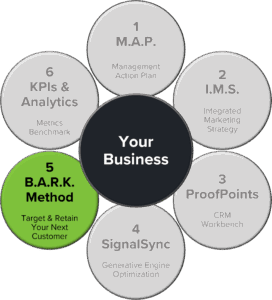
When these elements stay connected, marketing stops feeling random. This is why B.A.R.K. follows MAP, IMS, and SignalSync in our framework. Those create structure and discoverability. B.A.R.K. ensures the business gets smarter because of it.
What Changes When B.A.R.K. Is in Place
Businesses that apply B.A.R.K. don’t suddenly do more. They do fewer things, better. Redundancy drops. Time is managed more efficiently. The story gets stronger and the results begin to amplify.
Over time, you’ll notice more direct conversations and a stronger customer fit with less wasted effort and steadier improvement. Translation: more leads, more sales, more time.
BrandID locks in the company’s story and voice so when AudienceMO personalizes content to the people who matter most, ReachIQ then scales communications to the right channels. To confirm the process is working, Knowledge+ connects performance tracking to your goals.
In 2025, SMBs that consistently refine their campaigns based on performance data
reported up to 25 percent lower acquisition costs compared to those that didn’t.
Momentum replaces guesswork.
B.A.R.K. isn’t about chasing metrics. It’s about listening well enough to earn traction. It helps your business notice what is relevant, how to respond with intention and improve consciously without burning out or starting over.
If SignalSync helped people find you, B.A.R.K. helps you understand them.
hat understanding is what turns discoverability into lasting relationships.
Our Promise
To build, and protect, the integrity and trust of the brands that we serve.
Call: 888.515.2789
Text: 614.665.1992
Email: info@efriendmarketing.com
OH Office: 8711 Arrowtip Lane • Lewis Center, Ohio 43035
CT Office: 32 Horseshoe Ridge Rd • Sandy Hook, CT 06482